
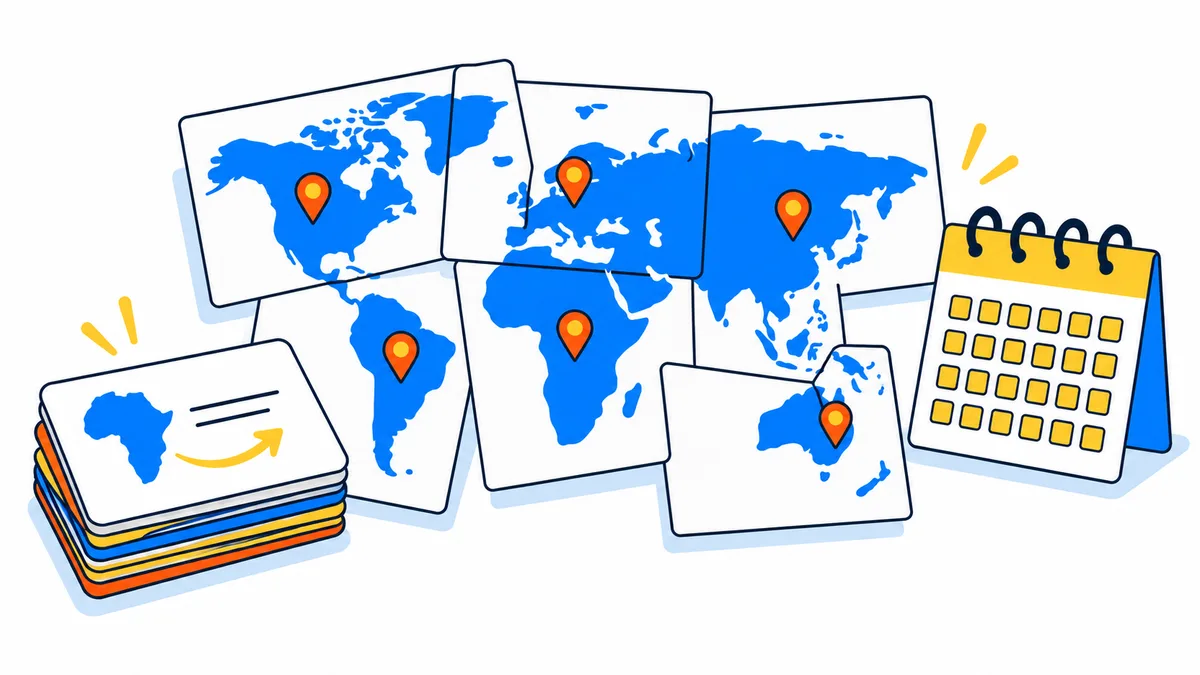
There are 195 countries on the usual list, and every one of them has a capital whose name has almost nothing to do with the country it belongs to. Thirty days is enough to learn all of them. It is not enough if you spend those days rereading.
Why capitals are hard to memorize
Volume is not the real problem. Most English speakers already know fifty or sixty capitals without having studied anything: Washington, Paris, London, Tokyo, Berlin, Rome, Madrid, Beijing, Moscow. You did not learn those. You absorbed them, because the country appeared in the news often enough that the pairing repeated itself.
The remaining hundred and thirty are different in kind. They are arbitrary sound pairs, and three specific things go wrong with them.
The word itself does not parse. You cannot recall "Ouagadougou" if you have never said it out loud and do not know where the stress falls. The same goes for N'Djamena, Nouakchott, Ashgabat, Thimphu, Yamoussoukro. Memory has nothing to grip, because there is no word there yet, only a row of letters.
The country itself does not parse. Knowing that Togo's capital is Lomé is worth very little if you have no picture of where Togo is or what surrounds it. The pair floats free. Ask yourself the same question a month later and there is nothing to hang it on. If the country's shape and scale are also fuzzy, Country Sizes is a round built to fix exactly that half of the problem.
Neighbors get swapped. This is the failure that actually hurts, because it is not a blank. It is confident and wrong. You have heard of Bamako, you have heard of Ouagadougou, and you attach them to the wrong two countries. The information is in there; the key is crossed.
Rereading fixes none of the three. A page of country and capital pairs looks like knowledge when you are reading it, because recognition feels almost identical to recall. Then the test asks you to produce a word from a blank, and the feeling was a lie. Every technique below exists to close that gap.
What you actually have to learn
The standard list runs to 195: 193 member states of the United Nations, plus the Holy See and Palestine, both permanent observers. Keep this sortable list of countries and capital cities open if you want to check the complete pairs while you work.
Continent counts are less settled than people pretend. Russia, Turkey, Georgia, Azerbaijan, Armenia and Cyprus sit on the boundary, and different lists push them one way or the other. The split below is one common version. It totals 195, and it is the one used in the schedule in the next section.
| Batch | Countries | What makes it hard |
|---|---|---|
| Africa | 54 | Least familiar capitals, most swapping between neighbors |
| Asia | 48 | Longest names, the "-stan" cluster, several capitals people confuse with commercial cities |
| Europe | 44 | Mostly easy; the small states are what catch people |
| North America | 23 | Few, but Caribbean capitals are small towns with similar-sounding names |
| South America | 12 | Straightforward |
| Oceania | 14 | Small island states with names you rarely see |
| Total | 195 |
Roughly a third you already know, a third you will get in a single exposure once you can pronounce them, and a third that need repeated retrieval because both halves of the pair are unfamiliar. The schedule treats them differently.
One more thing to check before you start: several capitals in older sources are simply out of date. Bujumbura is no longer Burundi's capital. Gitega took over in 2019. If your mental file was built from a school textbook, it may be carrying stale entries, and a stale entry is worse than a missing one because it answers confidently.
The four moves that do the work
1. Make the word pronounceable before you try to remember it
Say each new capital out loud three times, with the stress marked, before attaching anything to it. A word you can say is a word you can hold for two seconds while you build the association.
- Ouagadougou: oo-wa-ga-DOO-goo (Burkina Faso)
- N'Djamena: en-jah-MEH-nah (Chad)
- Nouakchott: noo-AK-shot (Mauritania)
- Yamoussoukro: ya-MOO-suh-kro (Côte d'Ivoire)
- Ashgabat: ash-GA-bat (Turkmenistan)
- Thimphu: TIM-poo (Bhutan)
This step takes about ten seconds per country and removes the most common reason a name will not stick.
2. Anchor each pair to one image you can actually see
You are not remembering a fact. You are remembering a picture with a label on it. The picture has to be concrete, specific and slightly wrong, because ordinary things are forgotten and strange ones are not.
If the country already has a strong image, use it. Egypt and pyramids, France and the Eiffel Tower, Japan and Mount Fuji. There is nothing to invent, so do not invent.
If it does not, build one from the sound of the capital itself:
- Bamako (Mali): a bamboo canoe on the Niger.
- Ouagadougou (Burkina Faso): the name already sounds like a war drum. Use it.
- Niamey (Niger): a nanny goat standing in the shallows of the Niger.
- N'Djamena (Chad): a jar of jam floating on Lake Chad.
- Nouakchott (Mauritania): a new shop with a striped awning in the middle of sand dunes.
- Conakry (Guinea): a cannon on the coast, because the capital sits on a peninsula.
- Lomé (Togo): an omelet on a plate.
- Accra (Ghana): a crate of gold dust. Ghana's name predates the gold, but the link holds.
- Dakar (Senegal): a dock, with a rally car parked on the end of it.
- Freetown (Sierra Leone): no image needed. The name says it.
- Monrovia (Liberia): the one true fact in this list. It is named after US president James Monroe.
The images are deliberately physical and slightly absurd. That is the point. A plausible, tidy association evaporates within a day.
3. Learn the confusable capitals together, not apart
If you study Mali on Tuesday and Burkina Faso on Friday, the two never compete, and competition is what teaches your brain which key opens which lock. Put every capital that could be swapped for another into the same fifteen-minute session and force the discrimination while both are still active.
This is the single biggest change most people can make. Blocking practice makes learning feel smooth and fast. Interleaving makes it feel slower and worse, and it is the one that survives the test.
4. Retrieve cold, in both directions, against a clock
Closed book. No rereading. No hints.
Half the drill is country to capital, because that is what a test asks. The other half is capital to country, and it is the half everyone skips. The reverse direction is how you find out whether you actually learned the pair or just learned to recognize a familiar answer. It also builds the index you need for a quiz that shows you the capital first.
Time it. A full pass over 195 countries in fifteen minutes is a reasonable end-state target, and having a clock on it stops the session from drifting into quiet recognition.
The 30-day schedule
Fifteen minutes a day: five minutes on new material, five minutes on yesterday's, five minutes on anything flagged in the last week.
| Days | Batch | New per day | Notes |
|---|---|---|---|
| 1 | Baseline | 0 | Cold test on 50 random countries. Mark only what you get without hesitating. |
| 2 | Repair | 0 | Pronounce every capital you missed or stumbled on. Learn the six continent buckets. |
| 3–7 | Africa | 10–11 | 54 countries across five days. Work the hardest sub-regions first. |
| 8–11 | Asia | 12 | 48 countries across four days. Longest names, so give pronunciation extra time. |
| 12–15 | Europe | 11 | 44 countries across four days. Fast, but do not skip the small states. |
| 16–18 | North America | 7–8 | 23 countries across three days. Caribbean clusters run long. |
| 19 | South America | 12 | Shortest batch. Twelve countries in one go. |
| 20 | Oceania | 14 | Small islands spread across a very large ocean. |
| 21–23 | Swap drill | 0 | Only the pairs you mixed up. Both directions. |
| 24–26 | Reverse drill | 0 | Capital to country, full list, untimed first then timed. |
| 27–29 | Full passes | 0 | Three cold runs over all 195. Time each one. |
| 30 | Final test | 0 | One cold pass. Record the time and the misses. |
Items you miss get retested the next day, then three days later, then seven, then twenty-one. Anything that survives the twenty-one-day mark can be left alone.
The review schedule is doing more work than the daily quota. Repetition on a clock is what turns one good evening into a month of retention.
One full day, worked through
Day 3 is Africa, and the first eleven are the West and Central African block that causes the most swapping. Here is the whole session.
| Country | Capital | Anchor |
|---|---|---|
| Mali | Bamako | Bamboo canoe on the Niger |
| Burkina Faso | Ouagadougou | War drum |
| Niger | Niamey | Nanny goat in the shallows |
| Chad | N'Djamena | Jam jar on Lake Chad |
| Mauritania | Nouakchott | New shop in the dunes |
| Senegal | Dakar | Dock with a rally car |
| Guinea | Conakry | Cannon on the peninsula |
| Guinea-Bissau | Bissau | The same cannon, smaller, and it is in the bay next door |
| Sierra Leone | Freetown | The name says it |
| Liberia | Monrovia | President James Monroe |
| Togo | Lomé | Omelet on a plate |
Run it like this. Two minutes saying the eleven capitals aloud with stress marked. Four minutes building the images, in order. Five minutes of closed-book recall, country to capital, with the ones you missed written down rather than looked up. Two minutes on the reverse direction for that shorter list. Then stop.
Note the seventh and eighth rows. Guinea and Guinea-Bissau sit next to each other on the coast and their capitals, Conakry and Bissau, get exchanged constantly. The paired cannon image is what stops that. This is move three doing its job.
The clusters that swap, and how to separate them
After the first pass, your misses will not be random. They will cluster.
| Cluster | The capitals | The tell |
|---|---|---|
| Sahel belt | Bamako (Mali), Ouagadougou (Burkina Faso), Niamey (Niger), N'Djamena (Chad), Nouakchott (Mauritania) | All long, all unfamiliar, all in a band across the top of Africa. Learn them in one sitting as a set of five rather than as five separate facts. |
| Congo pair | Brazzaville (Republic of the Congo), Kinshasa (DR Congo) | They sit directly across the Congo River from each other, which is why they travel in pairs. Brazzaville is the smaller and older of the two; Kinshasa is several times its size. |
| Gulf | Doha (Qatar), Kuwait City (Kuwait), Manama (Bahrain), Abu Dhabi (UAE), Muscat (Oman), Riyadh (Saudi Arabia) | Two are traps: Dubai is not the UAE's capital, and Jeddah is not Saudi Arabia's. |
| Central Asian "-stan" capitals | Kabul (Afghanistan), Astana (Kazakhstan), Bishkek (Kyrgyzstan), Islamabad (Pakistan), Dushanbe (Tajikistan), Ashgabat (Turkmenistan), Tashkent (Uzbekistan) | Two of them tell you what they mean. Astana is Kazakh for "capital". Dushanbe is Tajik for "Monday", after the market day. |
| Caribbean towns | Havana, Kingston, Port-au-Prince, Santo Domingo, Nassau, Bridgetown, Castries, Roseau, Basseterre, St. John's, St. George's | Almost none are big cities, and the name rarely hints at the country. St. George's and St. John's are parish names, Basseterre is French for low ground, Roseau is cane. Learn them as a row of small towns with nothing in the label to lean on. |
The same crossing happens with flags. Two neighboring countries get each other's flags swapped just as often as they get each other's capitals, and World Flags is the round that separates them.
The Gulf row deserves attention, because it is where most otherwise-solid learners lose points. The instinct is that the famous city is the capital. Dubai is not it. Jeddah is not it. The capital is Abu Dhabi. The next section is a longer list of countries where that same instinct hands you the wrong answer.
Capitals that are not the biggest city
This is the pattern behind a surprising share of missed questions, and once you have seen the list you stop making the error.
| Country | Capital | The city you were going to say |
|---|---|---|
| United States | Washington, D.C. | New York City |
| Canada | Ottawa | Toronto |
| Australia | Canberra | Sydney or Melbourne |
| Brazil | Brasília | Rio de Janeiro |
| Nigeria | Abuja | Lagos |
| United Arab Emirates | Abu Dhabi | Dubai |
| Turkey | Ankara | Istanbul |
| Morocco | Rabat | Casablanca |
| Switzerland | Bern | Zürich |
| Cameroon | Yaoundé | Douala |
| Côte d'Ivoire | Yamoussoukro | Abidjan |
| Tanzania | Dodoma | Dar es Salaam |
| Kazakhstan | Astana | Almaty |
| Pakistan | Islamabad | Karachi |
| Myanmar | Naypyidaw | Yangon |
Several of these capitals were built for the job. Washington was sited on the Potomac as a compromise in the 1790s, Ottawa was selected in 1857, Canberra was chosen as a tiebreak between Sydney and Melbourne, Brasília was inaugurated in 1960, Abuja replaced Lagos in 1991, Naypyidaw took over from Yangon in 2006, Astana replaced Almaty in 1997, and Gitega replaced Bujumbura in 2019. Almost none of them earned the role by being the largest city. They were picked by a legislature, a monarch or a committee, and several were drawn from scratch on empty ground. That is why the unfamiliar names are unfamiliar. They are not the cities that turn up in the news.
Countries that have more than one capital
Eight countries run more than one, and quizzes like asking which one is which.
| Country | Capitals | Division |
|---|---|---|
| South Africa | Pretoria, Cape Town, Bloemfontein | Executive, legislative, judicial |
| Bolivia | Sucre, La Paz | Constitutional capital, seat of government |
| Sri Lanka | Sri Jayawardenepura Kotte, Colombo | Legislative capital, commercial center |
| Netherlands | Amsterdam, The Hague | Capital, seat of government |
| Benin | Porto-Novo, Cotonou | Official capital, seat of government |
| Eswatini | Mbabane, Lobamba | Administrative, royal and legislative |
| Malaysia | Kuala Lumpur, Putrajaya | Capital, federal administrative center |
| Tanzania | Dodoma, Dar es Salaam | Official capital, largest city and main port |
South Africa is the one to learn properly, because the three are genuinely constitutional rather than ceremonial: the executive sits in Pretoria, Parliament sits in Cape Town, and the Supreme Court of Appeal sits in Bloemfontein.
For the rest, the pattern is the same everywhere. One city is written on the map as the capital, and another is where the government physically works.
How to review so it survives past day 30
The 30-day schedule gets the material in. Keeping it is a different job.
- Run the four-interval review. Missed items return after one day, three days, seven days and twenty-one days. Anything you still get right on day twenty-one can be dropped from the rotation.
- Keep both directions going. Country to capital and capital to country, every session. A pair you can only read one way is half learned.
- Time the full pass. Target fifteen minutes for 195. Under pressure is where crossed keys show up.
- Do one maintenance pass a week for the month after. Ten minutes, full list, no new material.
For practice, Capital Cities on QuizTell runs a ten-question round drawn from a bank of 334 reviewed capital questions, with the answer and a short explanation after each one. The explanations matter more than the score. They tell you which neighbor you are likely to have swapped in.
Test yourself
Two rounds are worth running once you have finished the schedule:
If you want a break from geography, today's Daily Quiz pulls ten questions from every subject, which keeps retrieval from freezing into one topic.