
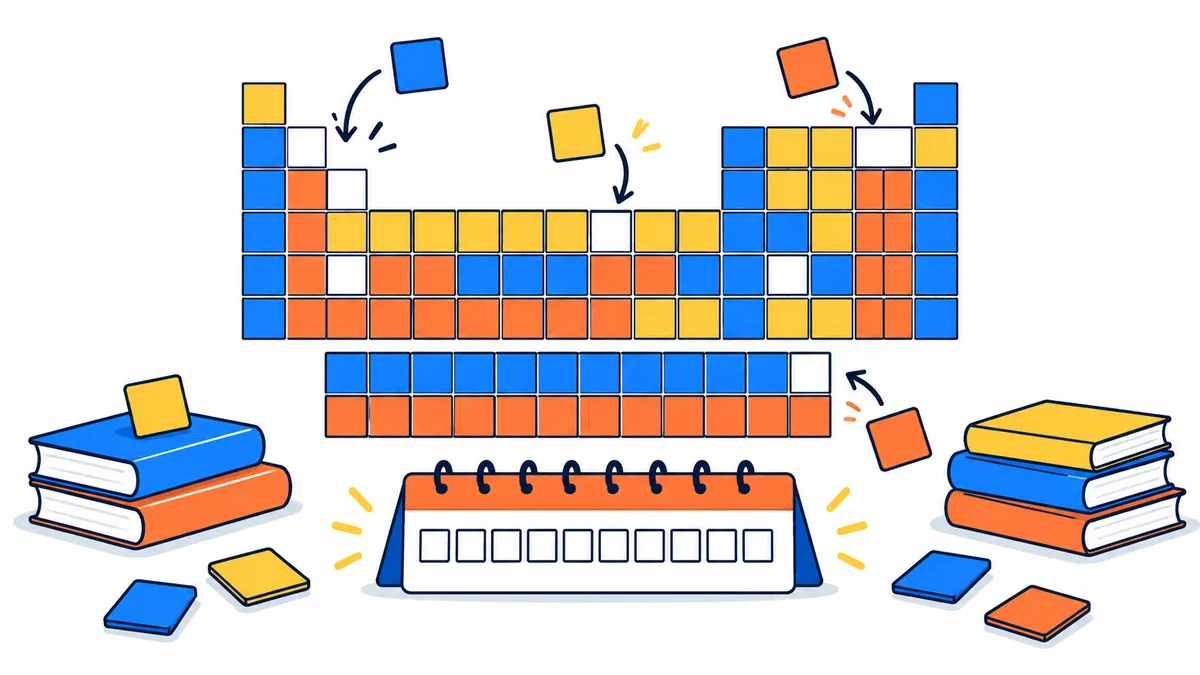
The periodic table has 118 entries and almost no story connecting them. That is why the usual advice is a memory palace or a hundred silly sentences, and why most people who follow that advice stop somewhere around element 40.
Before any of that, there is a smaller question that almost nobody asks.
What you are actually being asked to remember
"Learn the periodic table" covers three different jobs, and they are not the same size. Picking the wrong one is why the effort feels wasted.
The first twenty. Hydrogen through calcium. What a first chemistry course tests before it gets to anything interesting. Twenty name-and-symbol pairs, and you are done.
Names and symbols, both directions. What you need to read a problem, follow an explanation, or answer a quiz round without stopping to decode. Most people who say they want the periodic table mean this one. It runs to a few dozen elements rather than all of them.
All 118, in order. What a memory competitor does, and what every "learn it in one night" page is selling. It is a genuinely different job. Order is a separate piece of information on top of the name and the symbol, and it is the piece you will never use if you are not reciting the table to someone.
| Job | What you hold | What it is for | Cost |
|---|---|---|---|
| First 20 | 20 name–symbol pairs | Passing an early course | A few evenings |
| Names and symbols | A few dozen pairs, both directions | Reading and quizzes | The subject of this article |
| All 118 in order | 118 ordered entries | Reciting the table | Weeks, plus a memory palace |
The cost column is an estimate from the schedule at the end of this article, not a measured figure. The point of putting it here is that the third row is not a slightly harder version of the second. It is a different task, and if you do not actually need it, you are about to waste a lot of evenings.
From here the article assumes job two.
Where everything sits
The single largest piece of the problem is that the table looks like a scattered map and is actually one repeating number.
Count the elements in each row:
fill order:   2 + 8 + 8 + 18 + 18 + 32 + 32  =  118
              p1  p2  p3   p4   p5   p6   p7
Seven numbers. They add up to exactly 118, and once you can say them you can put any element in the right row without having memorized where it goes.
The wall chart does not show this, and that is where most people's confusion starts. Rows six and seven fill to 32 elements each, but 32 columns will not fit on a page, so the chart pulls fifteen of them out and parks them in a strip underneath:
period 1 | H                                                   He
period 2 | Li Be                              B   C   N   O   F   Ne
period 3 | Na Mg                              Al  Si  P   S   Cl  Ar
period 4 | K  Ca Sc  Ti V  Cr Mn Fe  Co Ni Cu  Zn  Ga  Ge  As  Se  Br  Kr
period 5 | Rb Sr Y   Zr Nb Mo Tc Ru  Rh Pd Ag  Cd  In  Sn  Sb  Te  I   Xe
period 6 | Cs Ba ·   Hf Ta W  Re Os  Ir Pt Au  Hg  Tl  Pb  Bi  Po  At  Rn
period 7 | Fr Ra ·   Rf Db Sg Bh Hs  Mt Ds Rg  Cn  Nh  Fl  Mc  Lv  Ts  Og
             |
             +-- the lanthanides sit in a strip below, not here
The · in the third column of the last two rows is the gap where that strip was lifted out. Everything else lines up.
Here is the payoff, worked through. Iron is in period 4, group 8.
rows before period 4:  2 + 8 + 8  = 18
position in period 4:  8th        =  8
                                       --
iron is element       18 + 8      =  26
You did not recall that. You computed it, using seven numbers and nothing else. Element 26 on any table is Fe, iron.
Two honest caveats. The arithmetic works cleanly through period five and gets fiddly in six and seven, because the strip has been moved out of sequence. And which element sits in that third column is a live convention: some tables put lanthanum and actinium there, others put lutetium and lawrencium. Pick whichever one your textbook or your quiz uses and stay with it, because both appear on reputable charts.
What the columns do
Columns are called groups, and there are eighteen of them. They are not arbitrary buckets, and they are the second half of the job.
Start with the split you can see. Everything on the left of the staircase is a metal: shiny, bends, conducts. Everything on the right is a nonmetal, which covers most of the gases and most of what you would never call a metal. The staircase itself holds the metalloids: boron, silicon, germanium, arsenic, antimony, tellurium and astatine. Position alone tells you which side of that line any element falls on, without looking anything up.
Four families carry almost all of the interesting behaviour:
| Group | Family | What they do |
|---|---|---|
| 1 | Alkali metals: lithium, sodium, potassium | One electron to give away. React with water |
| 2 | Alkaline earth metals: beryllium, magnesium, calcium | Two to give away |
| 17 | Halogens: fluorine, chlorine, bromine, iodine | One electron short. Take rather than give |
| 18 | Noble gases: helium, neon, argon, krypton, xenon | Shell is already full. Nothing to give, nothing to take |
Hydrogen sits in group 1 and is not an alkali metal. It is a gas, and it behaves like nothing else in its own column. Every table shows it there anyway.
Groups 3 to 12 are the transition metals, the wide middle block. Iron, copper, silver and gold live there. It is the part you would picture when someone says "metal", and it is the least sharply distinguished of the eighteen, which is why nobody memorizes it as a list.
The part that makes groups useful rather than decorative: group 1 has something group 17 wants. Put sodium and chlorine together and the exchange is the reaction you have seen in a school demonstration, and the product is table salt. Put anything from group 1 near water and it goes. Put anything from group 18 near anything and nothing happens at all.
That is the whole social structure of the table in three sentences, and it is why position predicts behaviour better than any list of properties you could memorize.
The ten symbols that do not start with their name
Here is a count that changes how the rest of this feels. Go through all 118 symbols and check whether the first letter matches the first letter of the English name.
Ten do not. Every other symbol on the table begins with the same letter as its name, which is why reading chemistry is far easier than it looks from outside.
The ten exceptions all disagree for a reason, and the reason is usually older than English:
| Symbol | Element | Where the symbol comes from | The hook |
|---|---|---|---|
| Ag | silver | Latin argentum, Greek argyros | Argentina is named from the same word: silver land |
| Au | gold | Latin aurum, same root as aurora | Aurora, dawn |
| Fe | iron | Latin ferrum | Ferrous, ferric |
| Pb | lead | Latin plumbum | Plumbing was lead work |
| Hg | mercury | Latin hydrargyrum, "water silver" | Quicksilver, the old English name for it |
| K | potassium | Latin kalium, from Arabic al-qalyah, plant ashes | Potash |
| Na | sodium | Latin natrium, from Greek nitron | German still says Natrium |
| Sn | tin | Latin stannum | Stannous, the tin-plating grade |
| Sb | antimony | Latin stibium | Stibnite, the ore |
| W | tungsten | German Wolfram, a mining term for the ore that seemed to swallow the tin it was smelted with | The German name, not the English one |
Ten stories is a much smaller job than a hundred and eighteen pegs, and a story occupies a slot you already have. You do not have to invent an image for Fe. You already know that ferrous means iron-based, which means the symbol is the root, which means the whole thing collapses into one fact you were going to learn anyway.
The caveat that keeps this honest: knowing the first letter only gets you started. It tells you that Sn is not sulfur and that Na is not nitrogen, and it narrows a multiple choice sharply. It does not spell the symbol for you, because the second letter comes from the Latin too.
Six crowded letters
The opposite failure is the one that actually costs you points. Because most symbols start with the right letter, six letters end up with a large family, and you will pick the wrong sibling rather than draw a blank.
| Letter | Common members | What separates them |
|---|---|---|
| C | C carbon, Ca calcium, Cr chromium, Co cobalt, Cu copper | Only carbon keeps the bare letter |
| N | N nitrogen, Ne neon, Na sodium, Ni nickel, Nb niobium | Sodium is Na because it is natrium |
| B | B boron, Ba barium, Be beryllium, Bi bismuth, Br bromine | Barium and beryllium are the trap pair |
| S | S sulfur, Si silicon, Se selenium, Sr strontium, Sc scandium | Silicon is Si. Sulfur keeps the bare letter |
| H | H hydrogen, He helium, Hf hafnium, Ho holmium, Hg mercury | Mercury is in this family for the wrong reason |
| F | F fluorine, Fe iron, Fr francium, Fm fermium | Iron does not start with F at all |
The families run larger than this. Carbon's has a dozen members on its own, and the table stops at the five you meet in a first course. What matters is the pattern: each of the six has at least four members, and each has exactly one element that keeps the bare letter. Carbon, nitrogen, boron, sulfur, hydrogen, fluorine. Learn those six and every other member has to be spelled out with a second letter, which immediately narrows the field.
Do not drill these one family per day. Put all six families in the same session and make yourself pick between calcium and carbon and chromium and cobalt and copper while they are all live. A family learned in isolation does not teach you to choose between its members, which is the entire problem.
The first twenty, run once
The method above applied end to end. Fifteen minutes.
Two minutes. Read the twenty names and symbols aloud, slowly, twice. You are not memorizing yet, you are just making the words pronounceable so there is something to attach to. The names are not all obvious either: beryllium, phosphorus and potassium are easy to skim past without hearing how they go.
Four minutes. Go down the list and note only the entries that surprise you. For most people that is a short list: P is phosphorus rather than lead, S is sulfur rather than silicon, C is carbon rather than calcium or chromium or cobalt or copper.
Five minutes. Closed book, name to symbol. Write what you miss rather than looking it up, and write only what you miss.
Two minutes. Symbol to name for that shorter list. This is the direction that finds out whether you learned the pair or learned to recognize it.
Two minutes. Positions. Take three from the list and work out their atomic numbers from the seven numbers: count the rows before, then add the place in the row. Potassium opens row four, so 2 + 8 + 8 gives 18, and it is the nineteenth.
| Z | Element | Symbol | Note |
|---|---|---|---|
| 1 | hydrogen | H | |
| 2 | helium | He | End of row one, noble gas |
| 3 | lithium | Li | |
| 4 | beryllium | Be | The beryllium in the B family |
| 5 | boron | B | Keeps the bare letter |
| 6 | carbon | C | Keeps the bare letter |
| 7 | nitrogen | N | Keeps the bare letter |
| 8 | oxygen | O | |
| 9 | fluorine | F | Keeps the bare letter |
| 10 | neon | Ne | |
| 11 | sodium | Na | One of the ten |
| 12 | magnesium | Mg | |
| 13 | aluminum | Al | |
| 14 | silicon | Si | Not S |
| 15 | phosphorus | P | Not Pb |
| 16 | sulfur | S | Keeps the bare letter |
| 17 | chlorine | Cl | |
| 18 | argon | Ar | End of row three |
| 19 | potassium | K | One of the ten |
| 20 | calcium | Ca | Not C. First element of row four |
Twenty entries, six of which are traps you already know about, and positions you can check against the seven numbers rather than trust.
The ten-day plan
Fifteen minutes a day. The last column is what "done" means, so you can stop guessing whether you have finished a stage.
| Days | Work | Done when |
|---|---|---|
| 1 | Choose your job from the first section. Read the fill sequence until you can write it from memory. | You can write 2 8 8 18 18 32 32 without looking |
| 2 | Learn the eighteen groups as behaviours, not names | You can name what the first, last and second-to-last columns do |
| 3–4 | The first twenty, both directions | Twenty for twenty in each direction, no hesitation |
| 5–6 | The ten foreign symbols and their roots | You can give the root for each of the ten |
| 7–8 | The six crowded families, all in one sitting | You can sort ten given symbols into the right family |
| 9 | Positions. Work out twenty elements from their rows and columns | Twenty correct, untimed first |
| 10 | Cold test. All three directions, timed | Recorded time, and a list of what you missed |
Anything you miss returns the next day, then three days later, then seven, then twenty-one. Whatever you still get right on day twenty-one leaves the rotation.
One weekly pass afterwards, ten minutes, full list, no new material.
Where this stops working
Four limits, stated so you do not discover them in the middle of day six.
Positions get unreliable in the last two rows. The fill arithmetic through period five is solid. In periods six and seven it breaks, because the chart has moved fifteen elements out of sequence. If you need to place a lanthanide, use the strip rather than the count.
The third column is a convention, not a fact. Lanthanum or lutetium, actinium or lawrencium. Both appear on reputable tables. Match whatever your course or quiz uses.
If job three is genuinely your job, this article is not enough. Reciting all 118 in order is a separate skill, and a memory palace is the right tool for it. Everything here still helps with the names and symbols underneath, but you will need something on top for the order.
The effort figures are estimates. They come from the schedule above, not from a curriculum standard or a measured study. Treat them as a rough shape for your own week and adjust.
Test yourself
Once the ten days are done, the two rounds worth running are:
And today's Daily Quiz pulls ten questions from every subject, which is a good way to notice whether the symbols have started to stick outside the chemistry context where you learned them.